Cloze vs Basic (Anki): The 2026 Decision Rule for Exam Prep
Cloze vs Basic in Anki — use this decision rule: cloze for exact missing pieces, basic for ideas. Covers Cloze 1 vs Cloze 2, type-in answers, and common card mistakes.
If you are comparing cloze vs basic Anki cards for an upcoming exam, the right answer is not "always use one type." The better answer is a simple decision rule: match the card type to the kind of recall you need.
That matters because many students build weak decks for a simple reason: they choose card format based on convenience instead of memory. A card can look fine when you create it and still be terrible two weeks later when it shows up in review.
This guide explains basic vs cloze Anki for exam prep, when each card type works best, what Cloze 1 vs Cloze 2 actually means, how type answer cloze works, how to adapt both formats to lecture notes and PDFs, and what to do if you want the best Anki card type for notes rather than a one-size-fits-all rule.
Studying on iPhone? Preview the package in the Anki .apkg viewer and import Anki decks on iPhone after you export a real .apkg.
The short version
Use cloze when the wording, sequence, or exact phrase matters.
Use basic cards when you need active recall of a concept, explanation, mechanism, or comparison.
If you turn every note into cloze, review becomes passive. If you turn every fact into basic cards, you can make simple memorization harder than it needs to be.
What is a cloze card in Anki?
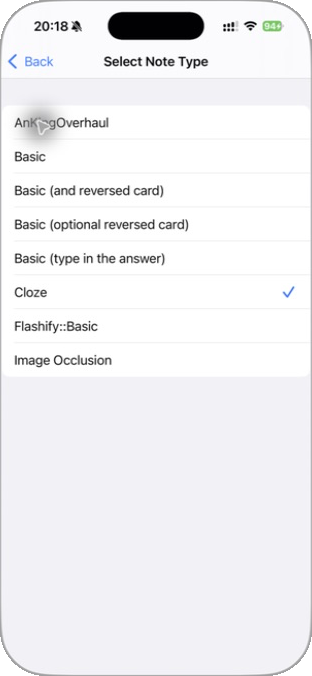
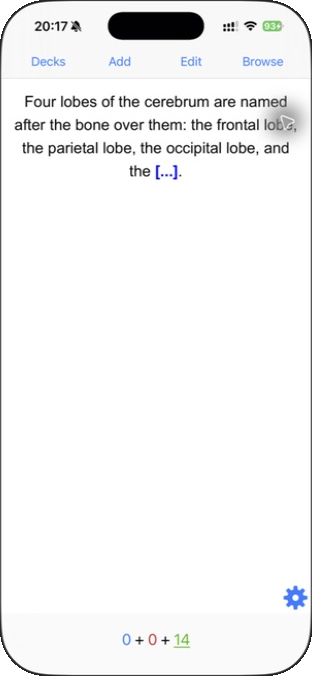
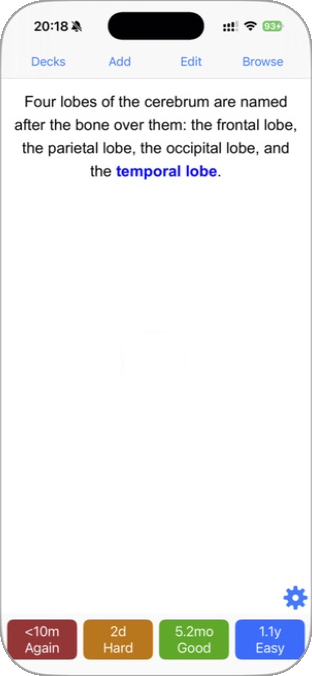
A cloze card is a sentence (or short block of text) with one or more pieces hidden. During review, you see the surrounding context and must recall the blank.
In Anki, cloze lives on its own Cloze note type. You write something like:
The triad of Horner syndrome is {{c1::ptosis}}, {{c2::miosis}}, and {{c3::anhidrosis}}.
Anki turns each deletion group into a card. The goal is active fill-in of a specific token, not free-form essay recall.
If you only remember the phrase "what is cloze in Anki," the practical answer is: it is context-preserving fill-in-the-blank, not a second Basic Q&A format with different branding.
When cloze cards are the better choice
Cloze cards are strongest when you want to preserve context but hide one key idea at a time.
They work well for:
- Definitions with one critical missing term
- Short lists where each item should be recalled separately
- Formulas, pathways, or sequences
- High-yield phrasing you need to recognize exactly
- Facts embedded in a sentence that already gives useful context
Examples:
The triad of Horner syndrome is {{c1::ptosis}}, {{c2::miosis}}, and {{c3::anhidrosis}}.
Cardiac output equals {{c1::heart rate x stroke volume}}.
For exam prep, cloze is especially useful when your notes already contain compact, well-written lines. If the source sentence is clean, cloze can keep the context while forcing recall of the important part.
Cloze 1 vs Cloze 2 (and c3, c4…)
Searchers often ask cloze 1 vs cloze 2 Anki as if they were two products. They are not. They are deletion groups on a single Cloze note.
{{c1::…}}is deletion group 1{{c2::…}}is deletion group 2- Each group generates its own card from the same note
On the card for group 1, only the c1 blanks hide; text in c2 stays visible. On the group 2 card, only c2 hides.
When to use separate groups
Use c1 vs c2 when each blank is an independent fact you want Anki to schedule separately. The Horner triad example above is the classic case: three findings, three independent retrievals, one shared sentence shell.
When not to split groups
Do not put every word on its own c-number. That creates a pile of nearly identical recognition cards. If two blanks only make sense together (one idea, one answer), keep them in the same group or rewrite as a Basic card.
Same group, multiple blanks
You can hide two spots with the same group:
{{c1::Na+}} and {{c1::K+}} are the main ions moved by the Na/K ATPase.
That produces one card where both blanks hide together. Use this when the co-occurrence is the point of the card.
Type answer on cloze cards
Type answer (also called type-in answer) is an Anki option that makes you type the hidden text before the answer is shown. It is especially useful for:
- Short, unambiguous strings (drug names, exact numbers, single terms)
- Stopping pure "I recognized the sentence shape" reviews
- Language vocab and formula fragments
It is a poor fit when answers are long, multi-word, or allow many valid phrasings — typing friction rises and scoring gets noisy.
In Anki Desktop, type-in is controlled on the note type / card template (look for type field / type answer behavior on Cloze). On mobile, support depends on the client; if typing is awkward on phone, keep type-in for desktop review sessions and use normal reveal on the go.
Bottom line for "anki cloze type answer": type-in raises the bar from recognition to production for short targets. It does not replace good card writing.
When basic cards are the better choice
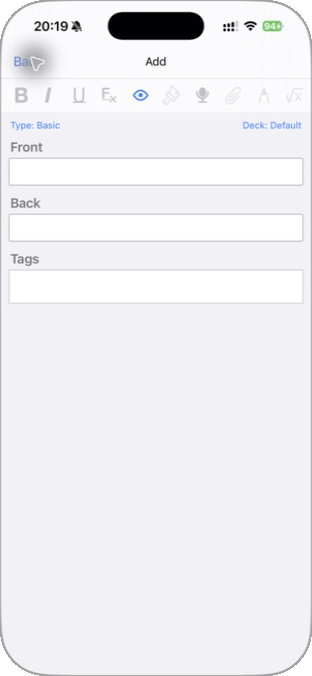
Basic cards are better when you want to retrieve an idea from scratch instead of recognizing a missing word in a sentence.
They work well for:
- Mechanisms and cause-effect relationships
- Comparisons between similar concepts
- Multi-step reasoning
- Questions that require explanation in your own words
- Broad notes that need to be broken into several atomic prompts
Examples:
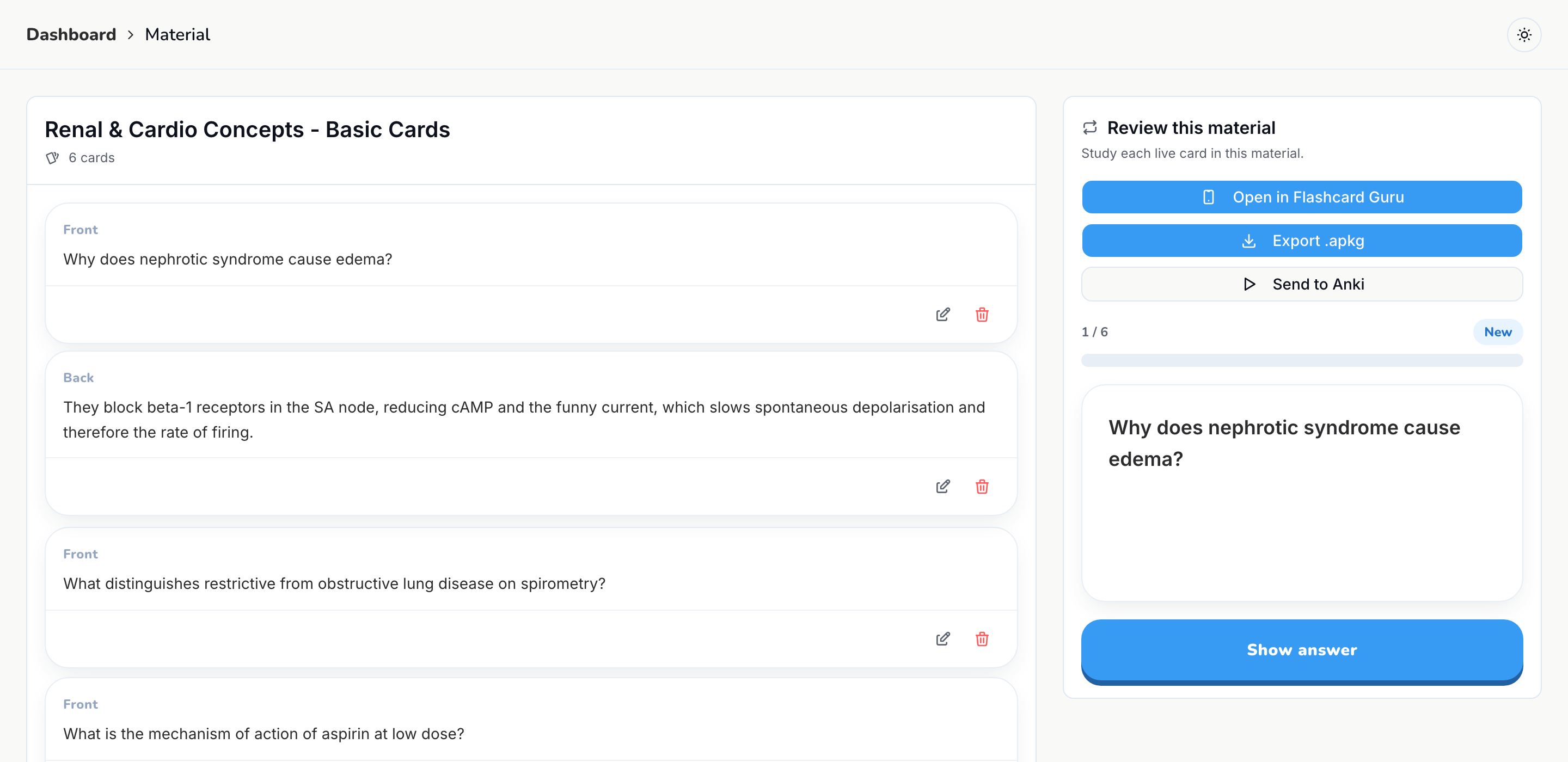
- Why does nephrotic syndrome cause edema?
- How do beta blockers affect heart rate?
- What is the difference between restrictive and obstructive lung disease on spirometry?
For most concept-heavy courses, basic cards are the default. They create stronger retrieval because the front of the card does not hand you the sentence structure.
Which card type is better for exam prep?
For most students, the best pattern is:
- Use basic cards for understanding
- Use cloze cards for exact wording and compact facts
That mix is usually better than trying to force your entire deck into one format.
If your exam emphasizes mechanisms, comparisons, applications, or "why" questions, basic cards should make up most of the deck.
If your exam emphasizes memorizing exact lists, rule elements, formulas, or tightly worded definitions, cloze deserves a larger role.
How lecture notes should affect the choice
Lecture notes are usually not written in clean flashcard form. They mix headings, examples, side comments, and partial explanations. That changes which card type works.
Use cloze from lecture notes when:
- A line is already compact and testable
- The wording is clean enough to preserve
- You only need to blank one or two terms
- The surrounding sentence helps you remember the concept
Use basic from lecture notes when:
- The note is long or messy
- One paragraph contains multiple facts
- The lecturer explained a process rather than a definition
- You need to split one note into several separate recall targets
If your source is messy class material, start with the workflow in How to Make Anki Cards from Lecture Notes. In most cases, you should clean and split the note first, then decide whether each resulting idea should become cloze or basic.
How PDFs should affect the choice
PDFs often make students overuse cloze because the source text feels polished. That is a mistake.
The right question is not "Can I hide words from this sentence?" The right question is "What do I want to retrieve during review?"
Cloze works better from PDFs when:
- You highlighted a short, high-yield sentence
- The line contains a definition, rule, or formula
- The sentence already has good context and only one key term needs hiding
Basic works better from PDFs when:
- The highlighted region is a paragraph, not a sentence
- The source explains a mechanism or comparison
- The text contains several ideas that should become several cards
- You want to avoid memorizing the visual rhythm of the sentence
If you are starting from highlighted documents, the workflow in How to Convert PDF to Anki is usually stronger than copying text directly into Anki. For a product path that drafts cloze-first cards from a lecture PDF, see the PDF to Anki converter.
Common misuses of cloze and basic cards
Misuse 1: turning every sentence into cloze
This is the most common error. The cards feel fast to make, but the reviews become weak because you start recognizing sentence shape instead of recalling the idea.
Misuse 2: writing broad basic cards
Some students avoid cloze entirely and then create giant basic cards with paragraph-long answers. That is just a different kind of bad deck.
Misuse 3: hiding too much in one cloze card
If the whole sentence disappears, you lose the contextual advantage that made cloze useful in the first place.
Misuse 4: using basic cards for pure wording tasks
If the goal is to remember the exact wording of a short rule element or formula, cloze is often more efficient.
Misuse 5: choosing by habit instead of by recall goal
Card type should follow the memory task. If the task changes, the format should change too.
Misuse 6: overusing c1/c2/c3 on dependent blanks
If blanks are not independent, separate deletion groups create redundant cards that train sentence recognition more than knowledge.
A practical rule for choosing fast
Ask one question before making the card:
Do I want to recall an idea, or do I want to fill in an exact missing piece inside a known sentence?
If it is an idea, choose basic.
If it is a missing piece in a sentence that already provides good context, choose cloze.
That single rule solves most "Anki cloze vs basic cards" decisions.
A good mixed workflow for exam prep
Here is a practical way to build a balanced deck:
- Highlight only the lines worth remembering.
- Split long notes into atomic ideas.
- Turn mechanisms, comparisons, and explanations into basic cards.
- Turn exact definitions, formulas, and short lists into cloze cards.
- Use separate c-groups only for independent facts; enable type answer only for short unambiguous targets.
- Review each draft against the source before export.
If you want to see what a polished study workflow looks like, start from the home page, try a free card demo on /try, compare plans on pricing, or browse showcases. Building decks on phone? See PDF to Anki flashcards on iPhone and open .apkg files on iPhone.